

Lace and Doily Fashion: The Unexpected Trend Taking Over Pinterest
- 1. Why This Isn’t Just Another ‘Cottagecore’ Echo
- 2. How Doilies Went From Grandmother’s Sideboard to Street Style
- 3. The Real Reason Lace Is Back (Hint: It’s Not Nostalgia)
- 4. Wearing Doily Fashion Without Looking Like You’re Cosplaying 1923
- 5. Lace Accessories That Actually Work in 2024
- 6. Pinterest Fashion Isn’t Just Pretty—It’s Predictive
- 7. Common Questions
- 8. Final Thoughts
You’ve seen it. That flat lay on your feed: ivory lace spilling over a raw-hem linen skirt, a single gold chain catching light at the collarbone, no filter, just natural light and quiet confidence. Most people scroll past thinking, “Too much.” Then they scroll back—and pause. Not because it’s dainty or quaint, but because it feels *alive*. Like someone took the quiet weight of old textiles and wired them straight into 2024’s nervous energy. Lace fashion isn’t whispering anymore. It’s leaning in. And you’re listening.
Why This Isn’t Just Another ‘Cottagecore’ Echo
Cottagecore was about hiding. This? It’s about showing up—with intention. Think of cottagecore as a sigh. Lace fashion is a raised eyebrow. One invited you to pour tea in a sun-dappled garden. The other has you walking into a co-working space in a black lace-trimmed blazer, sleeves rolled just so, carrying a tote that says *“I know what I’m doing”*—not *“I wish I were somewhere else.”*
This isn’t romantic style as escape. It’s romantic style as armor. A sheer lace overlay on a structured wool mini skirt. A vintage doily resewn across the back yoke of a crisp white shirt—not as decoration, but as punctuation. What makes it land on Pinterest fashion feeds isn’t prettiness. It’s friction: lace against leather, openwork against rigidity, softness with serious shoulders. That contrast is why it reads as modern vintage—not costume, not echo.
How Doilies Went From Grandmother’s Sideboard to Street Style
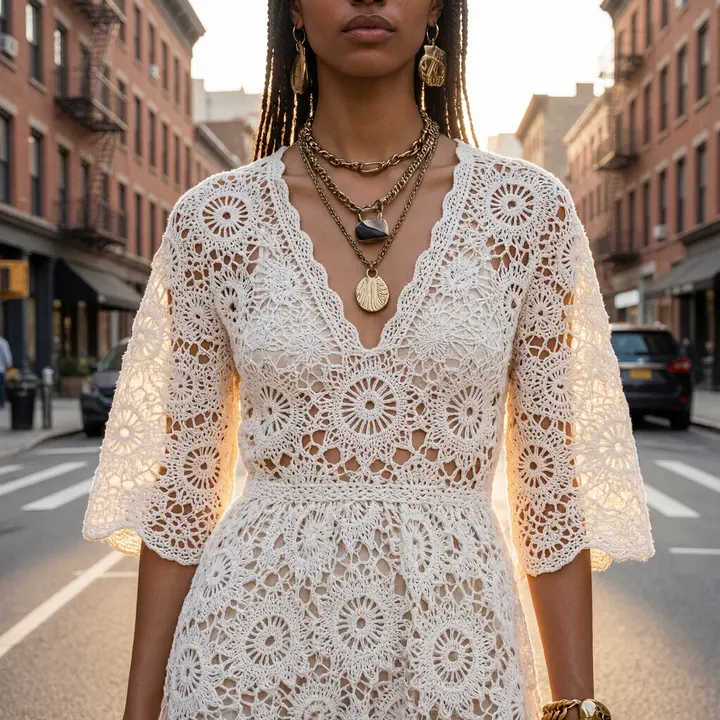
Here’s what nobody’s saying out loud: this trend didn’t go viral because it looked nice. It went viral because it *felt* right—literally. Texture stacking is the real engine behind those top-performing pins tagged #bohofashion or #feminineoutfits. Scroll through any of them and you’ll spot the formula: a ribbed knit sweater, a slub-weave cotton skirt, then—right on top—a layer of something airy and architectural. That’s the doily. Or its cousin: a deadstock lace panel cut to mimic that precise, open geometry.
Designers didn’t start with nostalgia. They started with a problem: how do you add depth without bulk? Answer: air. Real doilies are about 60% negative space—light passes through, shadows shift, movement catches the eye. That’s why they photograph like magic in golden hour—and why they work so well layered over summer pieces. One stylist I spoke with sources hand-crocheted Irish doilies from sellers in County Clare, then stitches them directly into the shoulder seams of oversized shirts—not as appliqué, but as structural reinforcement. It’s not embellishment. It’s engineering.
The Real Reason Lace Is Back (Hint: It’s Not Nostalgia)
Nostalgia gets the headlines—but fabric science got the sales. Last quarter, lace bodysuits outsold basic ribbed knits on two major European e-comm sites. Not because people missed their grandma’s dresser. Because today’s lace *works*. Tencel-lace blends breathe like mesh but hold shape like shirting. Recycled nylon lace with 3D stretch recovery doesn’t sag when you sit—or cling awkwardly mid-step. And because it’s often woven *into* the base textile (not stitched on top), it doesn’t peel, pucker, or demand dry cleaning after three wears.
That performance shift is why lace is popping up where you’d never expect it: lace-integrated bike shorts (lined, opaque, supportive), cargo pants with delicate trim along the outer seam, denim jackets with full lace panels across the back. Romantic style used to mean compromise. Now it means choice—without trade-offs. That’s the real reason it’s trending outfits everywhere from Depop to Dover Street Market.
Wearing Doily Fashion Without Looking Like You’re Cosplaying 1923
Start by cutting one thing. Seriously—if your outfit has ruffles *and* puff sleeves *and* lace, drop one. Every time. Romantic style only lands when it’s interrupted. Try this instead: a high-neck lace cami with clean, geometric openwork (no scallops, no flounce), tucked into wide-leg, high-waisted trousers in stiff wool crepe. Add thin gold hoops and loafers with a modest heel. Done. Feminine outfits—zero costume energy.
Or go monochrome: black lace crop top + black satin slip skirt + black vinyl trench. Suddenly, the lace isn’t telling a story—it’s adding texture. That’s the pivot. When lace stops being a theme and becomes *material*, it sheds its vintage fashion trend baggage and starts functioning like any other design language: deliberate, modern, and quietly powerful. Pro tip: head-to-toe lace is fine for a music video. For brunch? Skip it. Or at least pair it with chunky boots and a cropped moto jacket.

Lace Accessories That Actually Work in 2024
Forget lace gloves (too literal) and lace chokers (too fragile). The accessories landing right now are built for real life—not photo shoots. Lace-trimmed bucket hats in stiff cotton canvas—they shade your eyes *and* signal you’re tuned in. Lace-edged silk scarves, cut long and narrow (think 8” x 72”), so they drape like liquid ribbon rather than a formal necktie. And lace-wrapped hair clips—specifically, oversized barrettes with a single band of guipure lace wound tightly around the metal base. They grip thick hair, stay put all day, and catch light like tiny stained-glass windows.
What’s vanishing? Anything with elasticized lace bands (they dig in, they flatten, they age fast) and lace belts with plastic buckles (they cheapen everything within a five-foot radius). If it feels like it belongs in a prop closet, it’s not an accessory—it’s set dressing.
Pinterest Fashion Isn’t Just Pretty—It’s Predictive
Pinterest isn’t just inspiration. It’s a live wire into what people are *actually* trying on, saving, and remixing—before it hits runways or retail. When users save pins labeled “modern vintage,” “stylish clothing,” or “fashion inspiration,” the platform tracks more than keywords. It watches how long they linger, whether they zoom in on stitching details, which other pins they save alongside it. Last fall, pins featuring lace-overlay slip dresses spiked 220% in saves *weeks before* any major designer showed them. Why? Because real people were already testing the math: lace + utility, heirloom textiles + downtown silhouettes, softness + structure.
That’s why this feels less like a flash-in-the-pan trend and more like infrastructure. It’s not being pushed by marketing teams—it’s being pulled by stylists building mood boards, small-batch makers selling lace-integrated separates on Depop, editors commissioning stories titled *“The New Utility of Romance.”* Pinterest fashion is where trends go to incubate—not debut.
Common Questions
Can I wear lace fashion if I don’t identify with traditionally feminine aesthetics?
Yes—and that’s part of what makes it feel fresh right now. Designers are cutting lace into boxy, deconstructed silhouettes, pairing it with utilitarian hardware like matte-black zippers and D-rings, and using it in stark monochrome palettes that mute any “girly” associations. Lace isn’t inherently gendered. Context is. A lace-paneled workwear shirt worn open over a band tee and cargo pants reads as intentional, not ornamental. It’s texture with attitude.
Where can I find quality lace pieces without spending hundreds on designer labels?
Head to Etsy—but search smart: try “Tencel lace deadstock” or “recycled nylon lace remnant.” Then take those remnants to a local seamstress who does simple alterations. A sleeveless shell, a cropped vest, or lace-trimmed cuffs added to a jacket you already own? All doable for under $150. Also check Japanese workwear brands like Kapital and Engineered Garments—they use lace in unexpected, non-frilly ways, and their entry-level pieces often hover between $120–$180. Stylish clothing doesn’t have to mean luxury pricing.
Is doily fashion sustainable, or is it just another fast-fashion trap?
It depends entirely on how it’s made—and how you wear it. Mass-produced polyester “doily-print” tops? No. But sourcing actual vintage cotton or linen doilies (fully biodegradable), then hand-sewing them onto organic cotton or Tencel bases? Yes—that’s slow, repairable, and materially honest. The trend stays sustainable only if we treat the lace as artifact, not ornament. If it’s disposable, it’s not doily fashion. It’s just another trend wearing a lace mask.
Final Thoughts
Lace fashion won’t last forever—but the shift it represents will. A new fluency in texture. A willingness to hold contradiction in one outfit: softness and strength, delicacy and durability, romance and rigor. That’s the real legacy. Not the lace itself—but the permission it gives us to rewrite what romantic style means, one intentional, unapologetic layer at a time.