

Personal Finance for Women: How to Start Investing With Any Income
- 1. Introduction
- 2. Why Women Should Prioritize Investing
- 3. Breaking the Myth: You Don’t Need a Fortune to Start
- 4. The Power of Compound Interest
- 5. Choosing the Right Investment Vehicles
- 6. Index Funds and ETFs: Your Best Friends
- 7. Building a Diversified Portfolio
- 8. Budgeting for Investing
- 9. Overcoming Common Barriers
- 10. Common Questions
- 11. Final Thoughts
Introduction
You don’t need permission. You don’t need a finance degree. And you definitely don’t need to wait until your salary doubles — or your student loans vanish — to start building real wealth. Most women I’ve coached over the past 12 years didn’t begin with a plan. They began with $200 in a Roth IRA, a Google search, and the quiet certainty that *someone* had to break the cycle. Turns out? That someone was them.
Why Women Should Prioritize Investing
Let’s get blunt: women live about five years longer than men on average — and yet earn roughly 82 cents for every dollar men earn over their careers. That gap isn’t just about fairness. It’s arithmetic. You’re likely to spend more years in retirement *and* have less saved going in. So when people say “investing is optional,” what they really mean — whether they realize it or not — is “financial independence is optional.” For women, especially those managing caregiving, part-time work, or career breaks, investing isn’t a luxury. It’s how you close the gap without asking anyone’s permission.
Breaking the Myth: You Don’t Need a Fortune to Start
“I’ll start when I have extra money.”
That sentence has derailed more financial plans than market crashes ever could. The truth? You can open a brokerage account today with $5 — yes, five dollars — and buy a slice of an index fund. Apps like M1 Finance or Fidelity let you invest fractional shares, so $10 buys you 0.03 shares of the S&P 500. What matters isn’t the size of your first deposit. It’s showing up consistently, even when it feels small. Because personal finance for women isn’t about hitting a magic number — it’s about claiming agency, one decision at a time.

The Power of Compound Interest
Compound interest doesn’t care how much you make. It only cares how long your money stays put. Here’s what that looks like in real life: if you invest $150 a month starting at age 28 — and earn a realistic 6.5% annual return after inflation — you’ll have about $320,000 by age 60. Start at 38? Same monthly amount gets you closer to $150,000. That’s not a flaw in the math. It’s proof that time is your most valuable asset — especially when you’re budgeting for investing on a tight income. Miss ten years, and you miss nearly half the growth. Start now, and you give yourself room to breathe later.
Choosing the Right Investment Vehicles
If you’ve ever stared at a brokerage platform and felt paralyzed by ticker symbols and jargon — same. The good news? You don’t need to understand derivatives or sector rotation to get started. In fact, the best beginner investing strategy for women (and honestly, for almost everyone) is boringly simple: pick one low-cost, broadly diversified fund, automate contributions, and ignore the noise. Everything else — stock picking, timing the market, chasing hot trends — is distraction dressed up as strategy.
Index Funds and ETFs: Your Best Friends
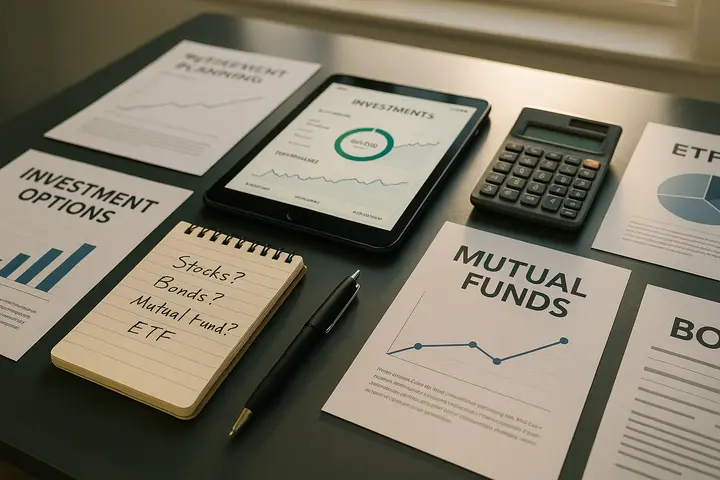
Think of index funds and ETFs like a well-stocked pantry. You wouldn’t try to grow every vegetable yourself — you’d buy a mix that covers nutrition, cost, and convenience. Same idea here. These funds hold hundreds — sometimes thousands — of companies across industries and countries. So when tech stumbles, healthcare might rise. When U.S. stocks dip, international markets may hold steady. That built-in balance is why they’re the backbone of wealth building for beginners. And because they’re passively managed, fees are usually under 0.10% a year — compared to 1%+ for actively managed funds. That difference adds up to tens of thousands over decades.
Building a Diversified Portfolio
Diversification isn’t about spreading money thin. It’s about spreading *risk*. A portfolio made up only of tech stocks is like wearing flip-flops in a snowstorm — fine until conditions change. Real resilience comes from mixing asset classes: U.S. stocks, international stocks, bonds, and maybe a dash of real estate (via REITs). For most women starting out, a simple 80/20 split — 80% in a total stock market index fund, 20% in a broad bond index — does 90% of the heavy lifting. No spreadsheets required. Just consistency — and the willingness to tune out the “what if?” noise.

Budgeting for Investing
“I can’t afford to invest” is usually code for “I haven’t carved out space for it yet.” Budgeting for investing doesn’t mean cutting your coffee habit or canceling Netflix. It means treating your future self like someone you love — and paying them first. Try this: set up an auto-transfer the day after payday. Even $25 a week ($100/month) becomes $1,200 a year — plus compound growth. That’s beginner investing that fits a low-income reality. And if your paycheck barely covers rent and groceries? Start with $5. Then $10. Then $20. The goal isn’t perfection. It’s momentum.
Overcoming Common Barriers
Fear of losing money? Totally valid. But here’s what nobody tells you: sitting in cash is riskier than you think. Inflation eats about 2–3% of your purchasing power every year. So that $1,000 in your savings account? In ten years, it buys what $750 buys today — even before taxes. Investing isn’t about avoiding risk. It’s about choosing *which* risks serve you. Market dips happen. Jobs end. Health changes. But time in the market — not timing the market — is what actually builds financial independence. Start small. Stay steady. Let your money do the heavy lifting while you live your life.
Common Questions
How much should I start with?
Whatever won’t make you panic when the market wobbles. Seriously — if $50 a month makes you sweat, drop to $25. If $25 still feels heavy, start with $10. The point isn’t to impress anyone. It’s to build the habit of showing up for yourself financially — regularly, quietly, and without fanfare.
What if I’m not sure where to invest?
Open a Roth IRA with a provider like Vanguard, Fidelity, or Charles Schwab — then buy one fund: VT (Vanguard Total World Stock ETF) or VTI (Vanguard Total Stock Market ETF). That’s it. One ticker. Zero guesswork. You’ll own pieces of nearly 10,000 companies worldwide. Later, you can add bonds or international exposure — but this single step covers more ground than most people ever do.
Is it too late to start investing?
No. Not at 35. Not at 47. Not even at 62 — though your timeline shifts. Starting later means leaning slightly more into consistent contributions (rather than relying on time alone), and maybe adjusting your stock/bond mix earlier. But the core principle holds: money invested today is still money working for you tomorrow. And tomorrow starts right now.
Final Thoughts
Financial independence isn’t about retiring early or buying a beach house. It’s about having options. It’s knowing you can walk away from a toxic job, take time off to care for a parent, go back to school, or just say “no” without calculating the cost in your head first. Investing isn’t complicated — it’s just unfamiliar. And familiarity comes from doing it, not studying it. So open the app. Make the transfer. Buy the fund. Your future self won’t send a thank-you note. But they’ll feel it — every time they choose freedom over fear.